

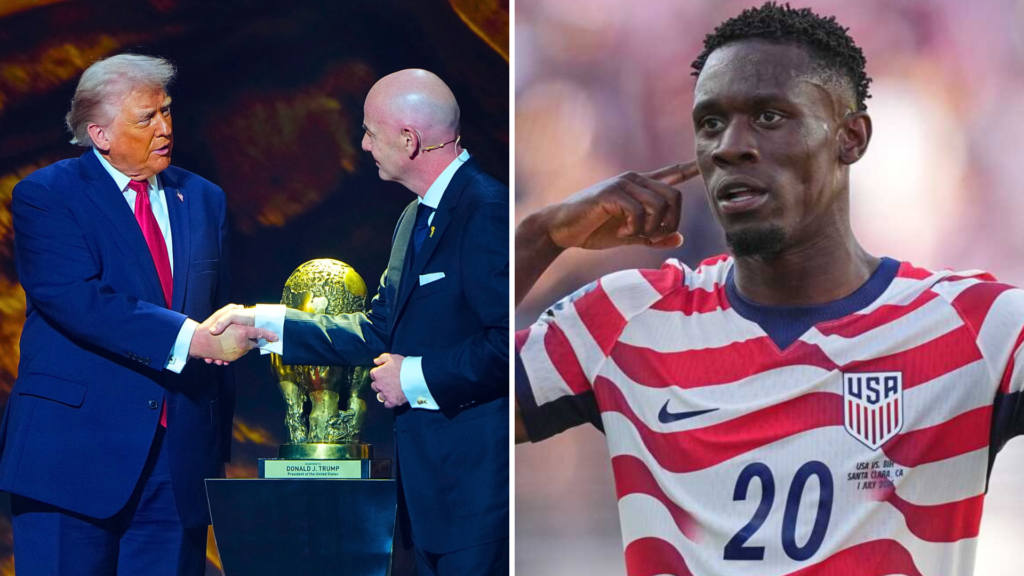
Folarin Balogun will be available for the United States in Monday’s World Cup round-of-16 match against Belgium, after FIFA suspended enforcement of his automatic one-game ban on a one-year probationary basis. The decision came after President Donald Trump reportedly urged FIFA to review the suspension and personally contacted FIFA president Gianni Infantino, according to multiple reports.
Balogun Cleared Before Belgium Match
Balogun had been set to miss the knockout match after receiving a red card in the United States’ 2-0 win over Bosnia and Herzegovina. FIFA’s disciplinary committee later placed the suspension on hold under Article 27 of its disciplinary code, making him eligible to face Belgium.
The ruling means the red-card suspension remains tied to a one-year probationary period. If Balogun commits a similar offense during that period, the suspension can be enforced along with any additional punishment.
Trump’s Role Adds Political Firestorm
The ruling quickly became bigger than a disciplinary decision.
The Associated Press reported Trump directly appealed to Infantino and asked FIFA to review the red card. The Guardian reported Trump made multiple calls lobbying FIFA to lift the ban.
Trump later publicly thanked FIFA for reversing what he called a “great injustice,” according to New York Post reporting.
Belgium Pushes Back
Belgium did not take the decision quietly.
The Royal Belgian Football Association said it was reviewing possible options after FIFA cleared Balogun, while Belgium manager Rudi Garcia criticized the timing and fairness of the decision.
For Belgium, the issue is clear: a red card usually triggers an automatic suspension for the next match. FIFA’s decision to delay enforcement changes the competitive setup one day before a knockout game.
Why Balogun Matters for the U.S.
This is a major boost for the Americans.
Balogun has scored three goals in the tournament and has become one of the most important players in Mauricio Pochettino’s attack. Without him, the U.S. likely would have needed to start Ricardo Pepi or Haji Wright against Belgium.
His speed, movement, and finishing have given the United States a central attacking threat it has often lacked in major tournaments.
U.S. Players Reacted With Surprise
U.S. players reportedly learned the news while traveling to training at the University of Washington.
Chris Richards said players were initially unsure whether the reports were real, while Christian Pulisic praised Balogun’s attitude and importance to the group, according to TalkSport.
The reversal immediately changes the tone of the Belgium matchup and gives the U.S. its preferred attacking structure back.
The Red Card That Started It
Balogun’s red card came in the 64th minute against Bosnia and Herzegovina after a VAR review of a challenge on defender Tarik Muharemović. The Guardian reported the original red card triggered an automatic one-game suspension, which initially appeared to rule him out against Belgium.
Balogun had argued the play lacked intent and should have been handled differently. Pochettino also called the challenge unintentional after the match, according to reports.
What It Means
On the field, this gives the USMNT a better chance to reach its first World Cup quarterfinal since 2002.
Off the field, FIFA’s ruling raises serious questions about consistency, political influence, and tournament integrity.
The United States gets its leading scorer back.
Belgium gets a controversy.
FIFA gets scrutiny.
The Majors Take
This is messy, even if the original red card looked harsh.
FIFA had a disciplinary mechanism available under Article 27, but the reported involvement of a sitting U.S. president makes the ruling feel politically loaded. That matters because this is not a friendly, it is a World Cup knockout match hosted partly by the United States.
Balogun being available is good for the U.S. soccer product. The process will be debated long after kickoff.