


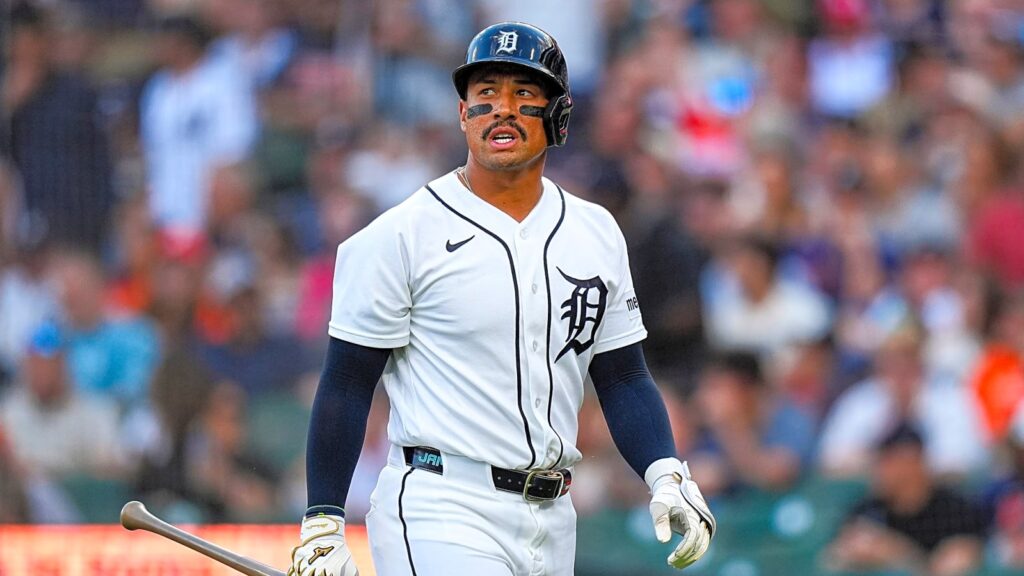
Boston announced the acquisition Tuesday and optioned infielder and outfielder Nate Eaton to Triple-A Worcester as the corresponding active-roster move.
The move gives Jones a fresh opportunity after Detroit designated him for assignment following a difficult first half of the season.
Detroit Turns Roster Decision Into Trade Return
The Tigers faced limited roster flexibility after Jones struggled to reproduce the success he enjoyed during the 2025 season.
Rather than lose Jones without receiving anything in return, Detroit found a trade partner willing to give the 28-year-old another opportunity.
The eventual value of the player to be named later is unknown, but receiving any return after removing Jones from the roster gives Detroit another asset while opening space for other players.
Jones Could Not Repeat His 2025 Success
Jones emerged as one of Detroit’s most effective role players during the 2025 season.
The right-handed hitter produced a .287 batting average, .387 on-base percentage and .550 slugging percentage across 150 plate appearances. He hit seven home runs and finished with a 159 wRC+, with much of his production coming against left-handed pitching.
His results declined sharply in 2026.
Jones hit .137 with a .219 on-base percentage and .221 slugging percentage before Detroit removed him from the roster. His strikeout rate climbed to 33.3 percent, while his overall offensive production fell to a 27 wRC+.
The Tigers gave Jones opportunities during April, May and June, but his playing time decreased as the offensive struggles continued.
Why Jones Became Expendable
Detroit has developed other options capable of filling specialized bench roles.
The emergence of Ben Malgeri and Eduardo Valencia reduced the need to keep a player whose primary value came as a right-handed hitter against left-handed pitching.
The Tigers also expect greater roster competition as Gleyber Torres and Javier Báez work toward returning from injuries. Their eventual availability would have created another roster squeeze for Jones.
Detroit also has several regular hitters producing against left-handed pitching, further reducing the need for a narrowly defined platoon specialist.
Boston Gives Jones a Fresh Opportunity
The Red Sox appear willing to see whether Jones can rediscover the offensive form he showed last season.
Boston has several left-handed hitters in its lineup and could use Jones as a right-handed bench option against opposing left-handed pitchers.
Jones does not need to become an everyday player to help Boston. A return to his 2025 production against left-handers would give the Red Sox another matchup option during the second half.
Fenway Park also offers an interesting setting for a right-handed hitter with pull power. The short distance to the Green Monster could reward Jones when he makes solid contact. This is an inference based on his offensive profile and Boston’s home ballpark.
What the Trade Means for the Tigers
The move gives Detroit greater roster flexibility.
Jones occupied a specialized role and struggled to provide enough production to justify keeping him on the active roster.
The Tigers now have more room to evaluate other bench options while preparing for the return of injured players.
Detroit also converted a designation for assignment into a trade return. The player eventually sent by Boston might carry limited value, but the Tigers avoided losing Jones without compensation.
The Majors Take
This move makes sense for both teams.
The Tigers gave Jones a legitimate opportunity after his productive 2025 season. His performance declined enough during the first half of 2026 that Detroit needed to explore other roster options.
Boston gives Jones another chance without making a major investment.
The trade also reflects the different pressures facing each club. Detroit needed flexibility. Boston saw an opportunity to add a right-handed hitter with a recent history of success against left-handed pitching.
Jones now has a fresh start.
The Tigers move forward with another open path for younger and more versatile players.